
The aim of the programme is to train engineers and researchers in optics, laser physics and optoelectronics. The E5 “Physics and Astronomy” speciality, full-time. In 2025 the state order was 15 places.
The programme was created in response to strong demand from research institutions, innovative companies and Ukraine’s defence industry for specialists with knowledge of optics, optoelectronics, optical measurement, data analytics, machine vision and programming.
Students start working in the laboratory in their second year. In the final semester they prepare and defend a thesis, presenting its results at international conferences.
Who you will be able to work as

Optical engineers and researchers at aerospace and defence enterprises and organisations.
Data science specialists, researchers and software engineers at corporations and research centres in Ukraine and worldwide
Specialists in setting up and developing optical medical equipment for diagnostics and treatment, and biomedical technology.
Developers of optical sensors, advanced optical materials, laser technology, optical electronics and more.

You will learn to
Analyse complex problems, think critically and develop innovative solutions
Design optical devices and optoelectronic systems
Apply lasers and optoelectronic systems across fields such as medicine, science, industry and defence
Use programming languages: C#, Java, Python, C++ and others
Manage engineering projects, including the design and alignment of optical systems and devices
Carry out optical measurements and diagnostics of advanced materials
The curriculum
The bachelor's programme has four parts: the physics and mathematics block, elective optics courses, programming, and soft skills.
 Physics and mathematics courses
Physics and mathematics courses
- Mechanics
- Molecular physics
- Mathematical analysis
- Linear algebra and analytic geometry
- Electricity and magnetism
- Optics
- Classical mechanics
- Electrodynamics
- Atomic physics
- Nuclear and elementary particle physics
- Quantum mechanics
- Thermodynamics and statistical physics
- Differential equations
- Probability theory and mathematical statistics
- Methods of mathematical physics
 Elective optics courses
Elective optics courses
In your third and fourth years you choose one of two elective blocks.
Optics and computer technology
- Computer-integrated measurement and data processing systems
- Computer technology in optical instrument design
- Fundamentals of modern microscopy
- Colorimetry
- Fourier optics
- Spectral methods in optical measurement
- Spectroscopy of atoms and molecules
- Semiconductor optics
- Fundamentals of laser physics
- Introduction to analogue electronics in optics
- Fundamentals of microcontroller programming
- Polarisation and interference methods of optical measurement
- Fundamentals of optoelectronics
Optics and laser physics
- Ultraviolet and X-ray optics
- Atmospheric optics
- Biomedical optics
- Fundamentals of computer vision
- Principles of optical spectroscopy
- Condensed matter spectroscopy
- Advanced optical materials
- Coherent optics
- Fundamentals of quantum electronics and nonlinear optics
- Infrared optics and thermal imaging technology
- Fundamentals of digital optoelectronics
- Crystal optics
- Interference and diffraction of light
- Optoelectronic devices and systems
 Programming
Programming
A separate block of the programme – the one that makes a graduate competitive beyond research alone. Languages: C#, Java, Python, C++.
- Programming
- Programming optical problems in Python
- Optical Data Science and Machine Learning
- Computer-aided design of optical systems
- Fundamentals of microcontroller programming
- Programming in Java or C++ – your choice
 Soft skills
Soft skills
Skills without which research does not happen: writing, presenting, working in a team and knowing your rights.
- Foreign language
- Introduction to university studies
- Ukrainian and world culture
- Philosophy
- Social and political studies
- Selected chapters of labour law and the basics of entrepreneurship
- Life safety with the basics of ecology
On top of that – taking part in the Optica and SPIE student chapters and in organising the international SPO conference, which the department holds every year.
Students have access to modern teaching laboratories and the equipment of the shared-access centre.
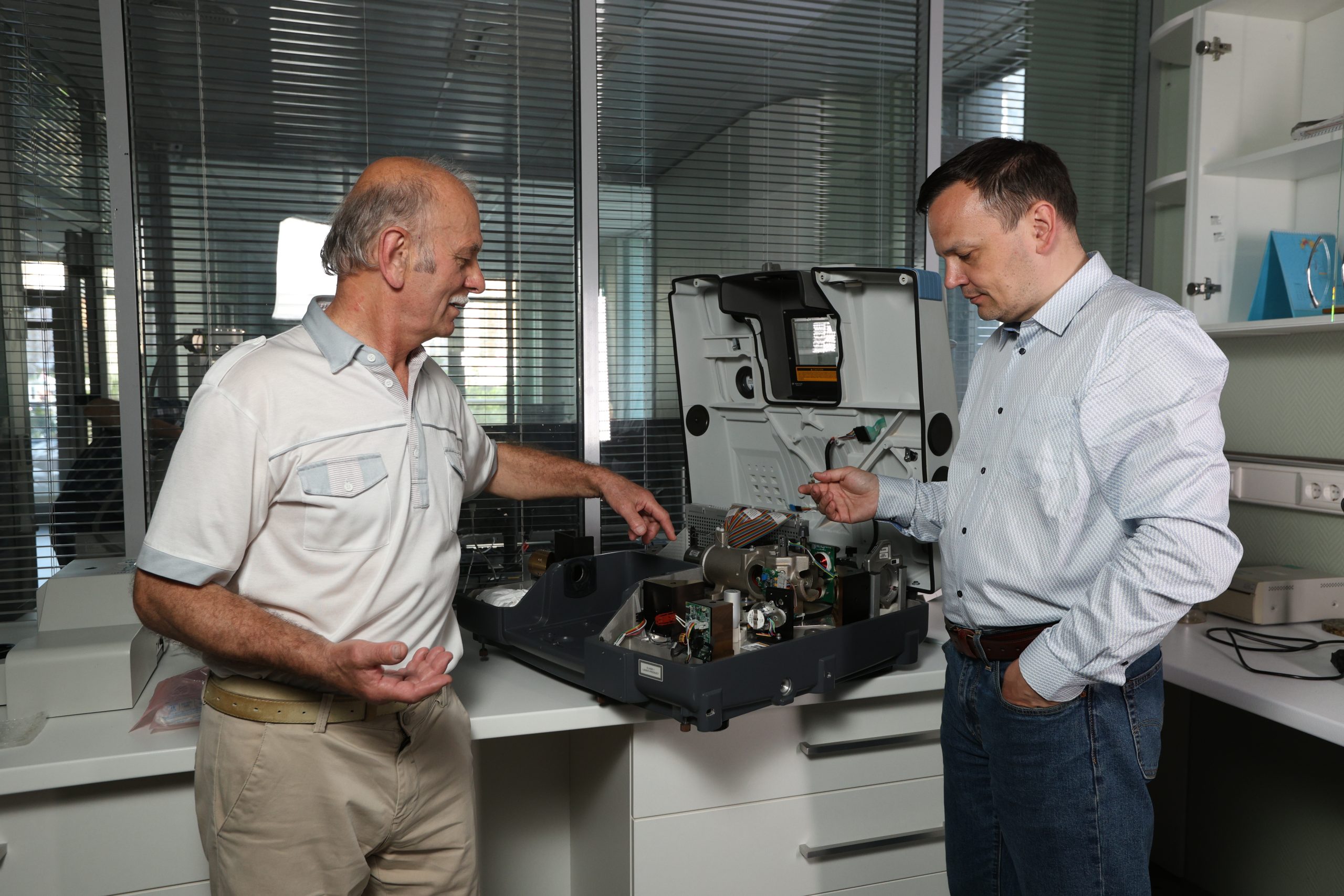 Working with an instrument's optical layout in the department's laboratory


