The Department of Optics of the Faculty of Physics, Taras Shevchenko National University of Kyiv, working since 1939. Modern optics is laser, photonic and optoelectronic technology: controlling light, transmitting and processing information, seeing the invisible and making ultra-precise measurements. Lasers, fibre-optic communications, photonic chips, thermal imaging, LiDAR, machine vision, optical sensors, medical diagnostics, quantum communications and systems for autonomous platforms.
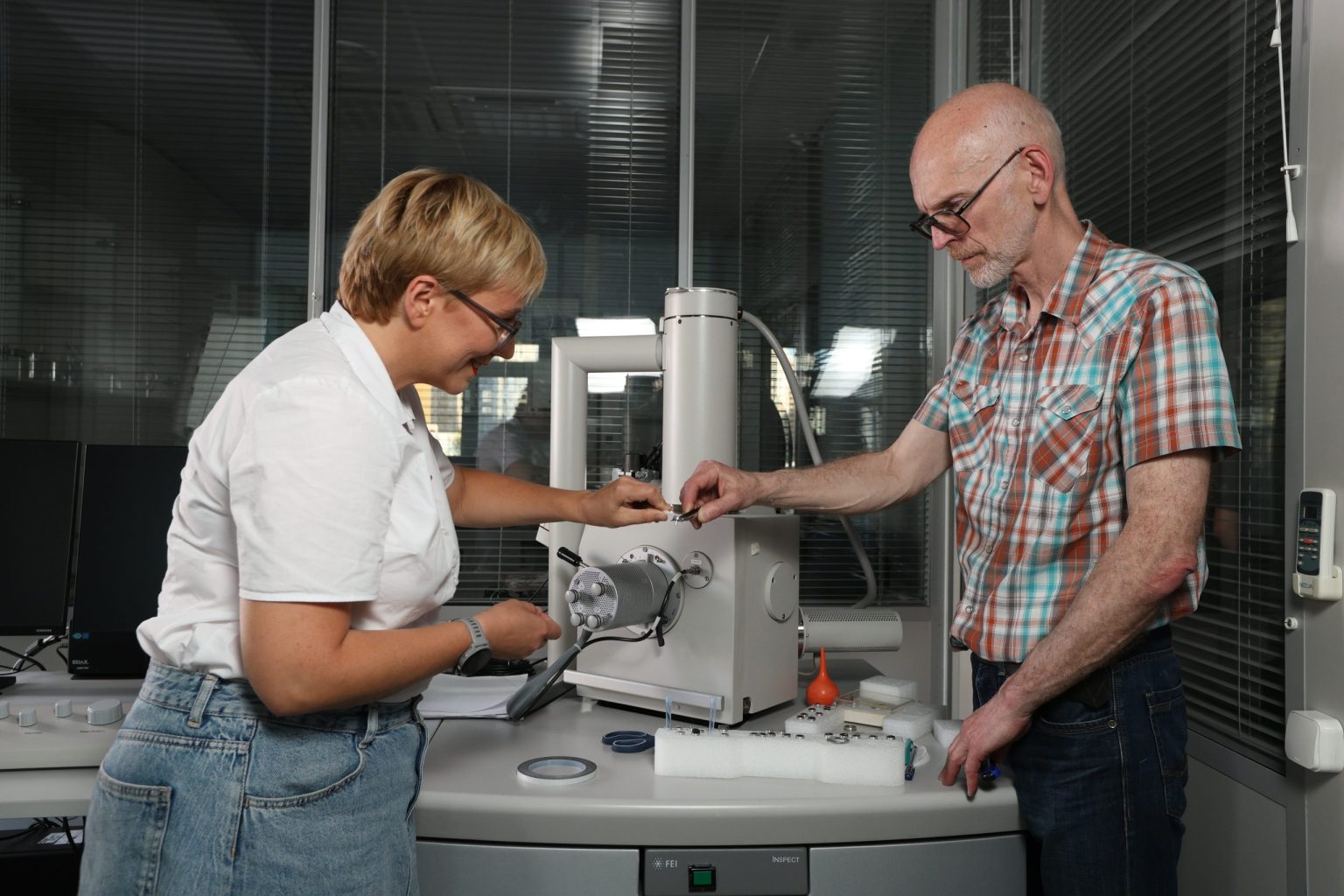
Loading a sample into the scanning electron microscope — Centre for Microscopy and Laser Spectroscopy, Faculty of Physics
The department in five figures
1939Year of foundation. The department was established by Oleksandr Shyshlovskyi, who led it for thirty-six years
1500+Graduates over the department’s history, among them two full members and four corresponding members of the National Academy of Sciences of Ukraine
26International SPO symposia held; the twenty-seventh takes place in September 2026
17SPIE scholarship holders among our students since 2008. SPIE is the international society for optics and photonics
7Laboratories of the department, where students work from their second year
Optics is already at work in your life
A smartphone camera, Face ID, fibre-optic internet, lasers and thermal imagers — this is modern optics. You use its technologies every day without even thinking about it.
Fibre opticsThe internet reaches your home as light running along a glass fibre thinner than a hair
Phone cameraA lens, a sensor and a lot of mathematics about how light becomes an image
LiDARA drone maps terrain by firing a laser pulse and timing its return
Thermal imagerShows a person in complete darkness, because the body glows in the infrared
Laser eye surgeryA surgeon corrects short-sightedness in about twenty seconds
SpectrometerSplits light into colours — and shows what a substance is made of without touching it
Behind each of these devices stands an optical physicist.
Where this department leads
Graduates of the department have worked in the groups of Nobel laureates and at the European X-ray free-electron laser.
Ihor Dotsenko · 2000Professor at the Université de Toulouse. From 2014 to 2023 at the Collège de France, in the group of Serge Haroche, Nobel laureate of 2012.
Vasyl Kravets · 1985University of Manchester, in the group of Konstantin Novoselov — the 2010 Nobel Prize for graphene.
Rostyslav Danylo · 2015Max Born Institute, Berlin: attosecond physics. Previously a doctoral candidate at the École Polytechnique in Paris.
Advanced materials for optics and semiconductor optoelectronicsDevelopment and research of GeSn, InGaAs, CIGS, CZTS and other semiconductor materials for creating radiation sources and detectors, solar cells and optoelectronic devices. One of the department’s strongest and most active research directions.
Solar energyDevelopment and research of new materials and photovoltaic structures for the efficient conversion of sunlight into electricity and the creation of next-generation solar cells. The direction is supported by international grants, including NATO, DAAD, DFG and CRDF Global.
Laser spectroscopy and fast processesHow matter responds to a powerful laser pulse — from Raman scattering and the glow of heated microparticles to random lasing, where scattering itself acts as the resonator.
Quantum materials and synchrotron researchTogether with the Kyiv Academic University and the Ukrainian synchrotron community USynC: photoemission and X-ray spectroscopy, access to the European XFEL, SOLARIS and the Paul Scherrer Institute.
Optical diagnostics of surfacesEllipsometry, speckle metrology and fractal analysis, plasmonic sensors: measuring thickness, roughness and optical constants without destroying the sample.
Optical technologies for MilTechThermal imaging systems, laser range-finding, night-vision devices, homing heads, optical navigation, computer vision, object detection and tracking are key components of modern MilTech. Students study the principles of optoelectronic devices, digital image processing and the development of optical modules. Training is provided by a dedicated block of elective courses and the department’s branch at the Arsenal enterprise, operating since 1984 and combining education with real engineering tasks.
The department’s research has been supported by four sources — two international and two Ukrainian. Students join these projects as paid members.
NATO SPSThe Science for Peace and Security programme. Project G5853 — innovative solar cells
CRDF GlobalProject FSA3-20-66707-0 — GeSn solid solutions for improved generation
NRFUThe National Research Foundation of Ukraine, project 2020.02/0134
MES of UkraineThe Ministry of Education and Science of Ukraine
0 UAHWhat state-funded students pay. Budget places on the Optics programme are available every year
SPIE grantsThe international society for optics and photonics gives the department educational grants of 3,000–11,000 dollars — the money buys equipment for teaching labs
Hrytseniuk and Melenevskyi FundA named scholarship for students of the department, with a competition every year
DAADThe German Academic Exchange Service funds a semester or an internship in Germany — our students go through the partnership with Chemnitz
Students enter the laboratory in their second year.
Scanning electron microscopeFEI Quanta 200F. Sees what no optical microscope can: surface relief at the nanometre scale
Raman microscopeRenishaw. Light scatters on molecules and returns changed — the change reveals what a substance is made of
Atomic force microscopeNT-MDT. A tip a few atoms thick traces the surface and maps its relief
Spectroscopic ellipsometerJ.A. Woollam M-2000. Measures film thickness in nanometres without touching it — from how light changes polarisation
Fourier-transform spectrometerSplits infrared light into a spectrum through interference — the way chemical bonds are found in a sample
High-power neodymium laserUsed to study what happens to matter under a high-energy pulse
The heaviest instruments are housed in the Faculty’s shared-access instrumentation centre — which means they are available both to the department’s students and to researchers from other institutions.
Step into a laboratory right now
No need to wait for an open day. Six laboratories have been filmed in panorama: rotate the view, walk up to the instruments and click the «i» circle to see what each one does and what problems it solves.
Two of the instruments are ours, at the Centre for Microscopy and Laser Spectroscopy of the Faculty of Physics. Four more are at Chemnitz University of Technology, where our master’s students go for internships. The tour was made together with Chemnitz with the support of DAAD.
Write to us — the head of the department or the admissions coordinator will reply.
Department of Optics, Faculty of Physics, Taras Shevchenko National University of Kyiv. 4 Akademika Hlushkova Avenue, Kyiv. Phone +38 067 401 58 16, email optics.phys@knu.ua.